What population of people are most at risk for becoming seriously ill due to a foodborne illness
As states and employers continue to reopen businesses and public offices, important decisions are beingness fabricated about how to keep workers condom from becoming infected with coronavirus at piece of work or on their commutes to and from their homes. In addition, outbreaks of coronavirus at some businesses, such every bit food processing facilities and long-term care facilities, highlight the risks faced past essential workers who take connected to work outside the dwelling house. Prophylactic considerations will be particularly important for those workers at greater risk of becoming seriously sick if they become infected with coronavirus. This caution applies to older workers in general, equally well as to younger workers with certain medical conditions that put them at college run a risk of serious illness if they go infected.
Nosotros use the National Health Information Survey (NHIS) to look at how many developed workersane are at increased risk of severe disease if infected with coronavirus, based on adventure factors identified by the Centers for Disease Control and Prevention (CDC). These risk factors include having diabetes, chronic obstructive pulmonary affliction (COPD), centre disease, a torso mass index (BMI) above 40, moderate to severe asthma, and a functional limitation due to cancer. All workers 65 and older also are considered at higher risk. The approach is similar to our prior work identifying at-risk adults and is described in more than item in the Methods.
Who are the At-Risk Workers?
We find that over ninety million adults are at greater risk for severe illness from COVID-19 due to underlying health conditions or age. Of these at-take a chance adults, nosotros judge that about 37.vii million were employed at a job or business concern in the prior twelvemonth, including 10 million people age 65 and older (19.five% of adults age 65 and older, all of whom are considered at greater risk) and 27.7 one thousand thousand non-elderly adults (Figure one). These at-run a risk workers comprise 24% of all adult workers.
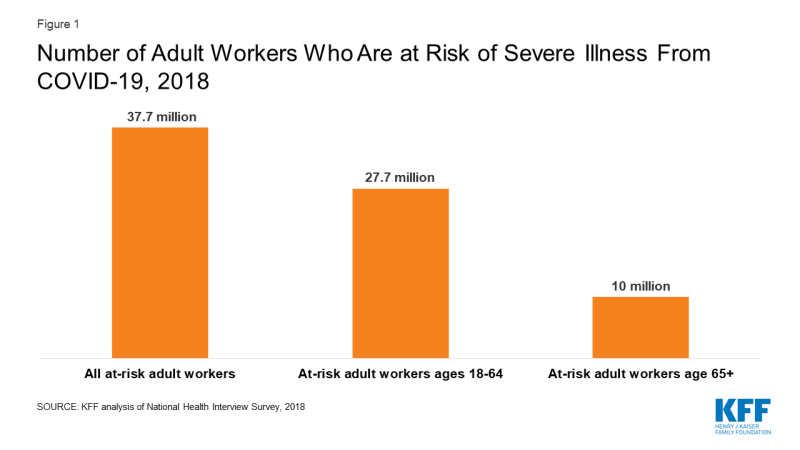
Figure 1: Number of Developed Workers Who Are at Adventure of Astringent Affliction From COVID-19, 2018
Amid not-elderly adult workers, at-adventure workers are older on average than not-elderly workers who are not at adventure (average age of 45 versus 40), reflecting the fact that risk status chronic conditions or poor health increases with age. Half of at-risk non-elderly adult workers are women, which is higher than the percentage (46%) of non-elderly developed workers who are non at adventure.
Large shares of at-gamble workers — 86% of not-elderly adult at risk workers and 61% of age 65 and older at-adventure workers — work total-time (at to the lowest degree 35 hours per week). They take substantial connection to piece of work and may face economic difficulties remaining absent-minded from their jobs even if safety is a question.
The average annual earnings of non-elderly adult at-risk workers was $48,400 in 2018, somewhat lower than the boilerplate annual earnings for non-elderly adults workers who were not at risk ($51,900). The median annual earnings was $40,000 for both at-risk and not-at-gamble developed non-elderly workers. One-quarter of non-elderly developed at-gamble workers had annual earnings of less than $21,100.
The average annual earnings of workers age 65 and older was $49,100 in 2018; median annual earnings were $37,000. One-quarter of workers age 65 and older had annual earnings of less than $17,300.
The importance of at-risk workers' earnings to themselves and to their families may put added pressure on them to go along to work or return to work even if their safe may be compromised. Not surprisingly, among both non-elderly at-run a risk workers and workers age 65 and older who live lone, earnings on average business relationship for a very big share of their full almanac incomes: 94% among not-elderly at-take chances workers and 72% amidst older at-take chances workers in 2018. For those living with others, the at-risk worker's earnings on average comprised a substantial share of family income. Among not-elderly at-risk workers, their earnings accounted for 57% of family income in families of 2 or 3 and 50% in larger families. Among workers historic period 65 and older who alive with others, the older worker'due south earnings on average comprised 48% of family income.
Word
Most people, including at-hazard workers, cannot afford to stay away from piece of work for long periods of time. Some people at risk take likely continued to go to work outside their homes due to the nature of their jobs, perchance equally essential workers. Others may have been accommodated past remote piece of work, which has taken concur to a remarkable degree but is not available to all workers. Some have lost their jobs or may be at run a risk of losing them. As more workplaces reopen there will be increasing pressures for all workers, including those at higher risk, to return to jobs or seek new jobs outside of their homes. This will raise issue both for employees concerned nearly their safety and for employers concerned virtually how to keep these workers safe.
In addition to at-risk people who are workers themselves, there are millions more at-risk adults who themselves are not workers but who live with workers. This indirect exposure could be just equally serious of a risk as going to work themselves. We estimate that an additional 12 million at-risk adults who are not workers themselves live with at least one total-time worker. This includes 6.5 one thousand thousand people age 65 and older and nigh 5.5 million at risk non-elderly adults. This is a bourgeois estimate because boosted non-working at-hazard adults live with people who piece of work part time or who are in and out of the work force. The safety of these family unit members volition need to be part of the considerations for employees and employers as businesses continue to refine prophylactic protocols and others reopen their workplaces.
Country and local governments and employers themselves are wrestling with how to reopen businesses in the safest ways possible, with risks peculiarly high for workers who have pre-existing that make them more vulnerable to severe illness from COVID-19. Employers, workers, and governments may need to consider flexible and artistic approaches to residual safety and business organization needs, simply with such large number of workers meeting vulnerability criteria, in that location will be a standing tension betwixt the economic pressures facing families and businesses and the wellness and safety of millions of people.
Methods
This analysis uses information from the 2018 National Wellness Interview Survey (NHIS) to wait at the share of workers who would exist at increased hazard of becoming seriously ill if they go infected with COVID-nineteen. The assay is like to our previous [work], where nosotros used the Behavioral Risk Factor Surveillance Survey (BRFSS) to estimate the number of adults who would be at increased risk if they were infected with coronavirus. In that study, we plant that about 21% of non-elderly adults have ane more than of five risk factors that the Centers for Disease Control and Prevention (CDC) have identified every bit increased risk factors for those infected with coronavirus. The factors we were able to analyze were having diabetes, chronic obstructive pulmonary disease (COPD), heart disease, a body mass index (BMI) above 40, and asthma. In addition, the CDC criteria consider all people over historic period 65 to be at increased risk. In this brief nosotros employ like information from the 2018 National Health Interview Survey (NHIS) to look at the share and characteristics of adults with these risk factors who are in the workforce.
We use NHIS rather than BRFSS for this analysis because it has more than information about the earnings, income and family characteristics of the at-adventure population, providing a fuller pic of the economic circumstances of these workers. The sample adult file in NHIS contains data near all of the same wellness atmospheric condition that we used in the previous written report, plus the person file has information that allows united states of america to include people who report being functionally express due to cancer; CDC includes people with compromised allowed systems, such as people undergoing handling for cancer, as beingness at higher risk of serious illness if infected with coronavirus. With NHIS we discover that 22% of not-elderly adults have one or more than take a chance factors for becoming seriously sick with COVID-19, essentially the same share equally we calculated under BRFSS. Including those with a functional limitation due to cancer accounts for less than one-one-half percentage bespeak of this judge. We note that one downside of using NHIS is that country-level assay is non possible.
As with BRFSS study, the assay identifies non-elderly people with one or more risk factors, only in ii steps. One pass excludes asthma and the other includes it, and we utilize only a portion (62%) of the people whose simply risk factor is asthma. Different our BRFSS analysis, hither we contain the proportion past assigning risk status to 62% of those whose only chance factor is asthma. The assignment is done by sampling from the asthma gamble only group in a way that increases the likelihood of selection with age. (See Zein et al.)
The purpose of the analysis is to wait at people who may have difficult avoiding or delaying work if their safety may be compromised; we therefore attempted to focus the assay on those with a meaning amount of piece of work, which we defined as workers who earned $5,000 or more at a task or business during the previous year. This threshold includes 94% of non-elderly adults and 88% of people historic period 65 and older with any work in the previous twelvemonth.
We imputed full-time or part-time status for some observations with missing values. NHIS provides a file that multiply imputes family unit income, earnings and work condition for survey respondents. This results in cases in which employment status and earnings are imputed for people who did not otherwise study beingness employed. Although NHIS contains several questions about hours worked (either in the previous period or usually), these questions do not comprise information for respondents who were imputed to be workers and to accept earnings. We imputed office-time/full-fourth dimension status based on their annual earnings, separately for workers under historic period 65 and those 65 and older. More specifically, for cases where we had information on earnings and hours worked, we calculated the relative proportions of function-time and full-time workers in several earnings groups. We then randomly imputed yes or no for full-fourth dimension status for the missing cases, using the probabilities associated with their income levels.
We calculated the share of earnings to family income, segmented by family unit size. For this assay, we wanted to summate the ratio for each worker in guild to make up one's mind the importance of that worker'southward earnings to the family unit. Doing this can create issues in cases where earnings are larger than family income, which can effect in very high ratios of earnings to income, which inflate the overall average. To limit the impact of these situations, we capped the ratio associated with any worker to i (a worker'due south earnings can account for 100 percentage of family income only not more than than that). A second issue is that the family incomes for some workers with meaning earnings can be very low or even zero. This was the case for a small number of observations of at-take a chance workers (between 6 and 12 unweighted cases had earnings of $5000 or more and family unit income of less than $1,000. Nosotros excluded those cases when we calculated the ratios.
Source: https://www.kff.org/coronavirus-covid-19/issue-brief/almost-one-in-four-adult-workers-is-vulnerable-to-severe-illness-from-covid-19/
0 Response to "What population of people are most at risk for becoming seriously ill due to a foodborne illness"
Post a Comment